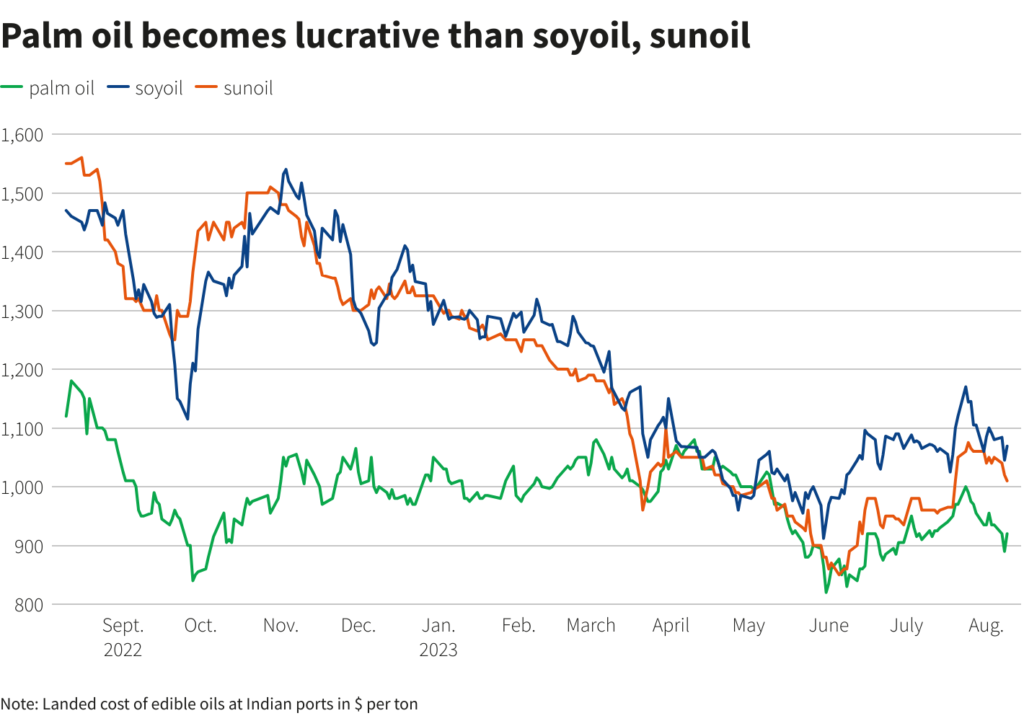
Over the past month, soybean oil prices have surged due to production issues in the United States and reduced supplies from Argentina, the largest exporter. Meanwhile, sunflower oil prices have risen after Russia withdrew from the Black Sea grain deal, according to a dealer from a global trading firm based in New Delhi.
The Black Sea region accounts for 60% of the world’s sunflower oil production and 76% of its exports.
“Palm oil prices haven’t risen; instead, they have decreased due to growing inventories in producing countries and have become even cheaper for buyers,” the dealer said.
Price-sensitive Asian buyers traditionally rely on palm oil due to its low cost and fast delivery times.
In addition to India, China, Bangladesh, and Pakistan have also increased their purchases of palm oil for deliveries in August and September, as reported by a trader from Mumbai.
China’s July import of vegetable oil, mostly consisting of palm oil, jumped by 48% compared to the previous year, reaching 778,000 tons.
The discount on palm oil compared to competing oils is likely to gradually decrease as growing exports lead to reduced stocks both in Malaysia and Indonesia, the trader stated.
According to the Malaysian Palm Oil Council, palm oil exports from Malaysia grew by 15.55% to 1.35 million tons in July. In the first ten days of August, Malaysian palm oil product exports rose by 17.5% to 383,795 tons, as reported by AmSpec Agri Malaysia on Thursday.